AI Project Failure Rate Statistics (2026): What Eight Studies Measure
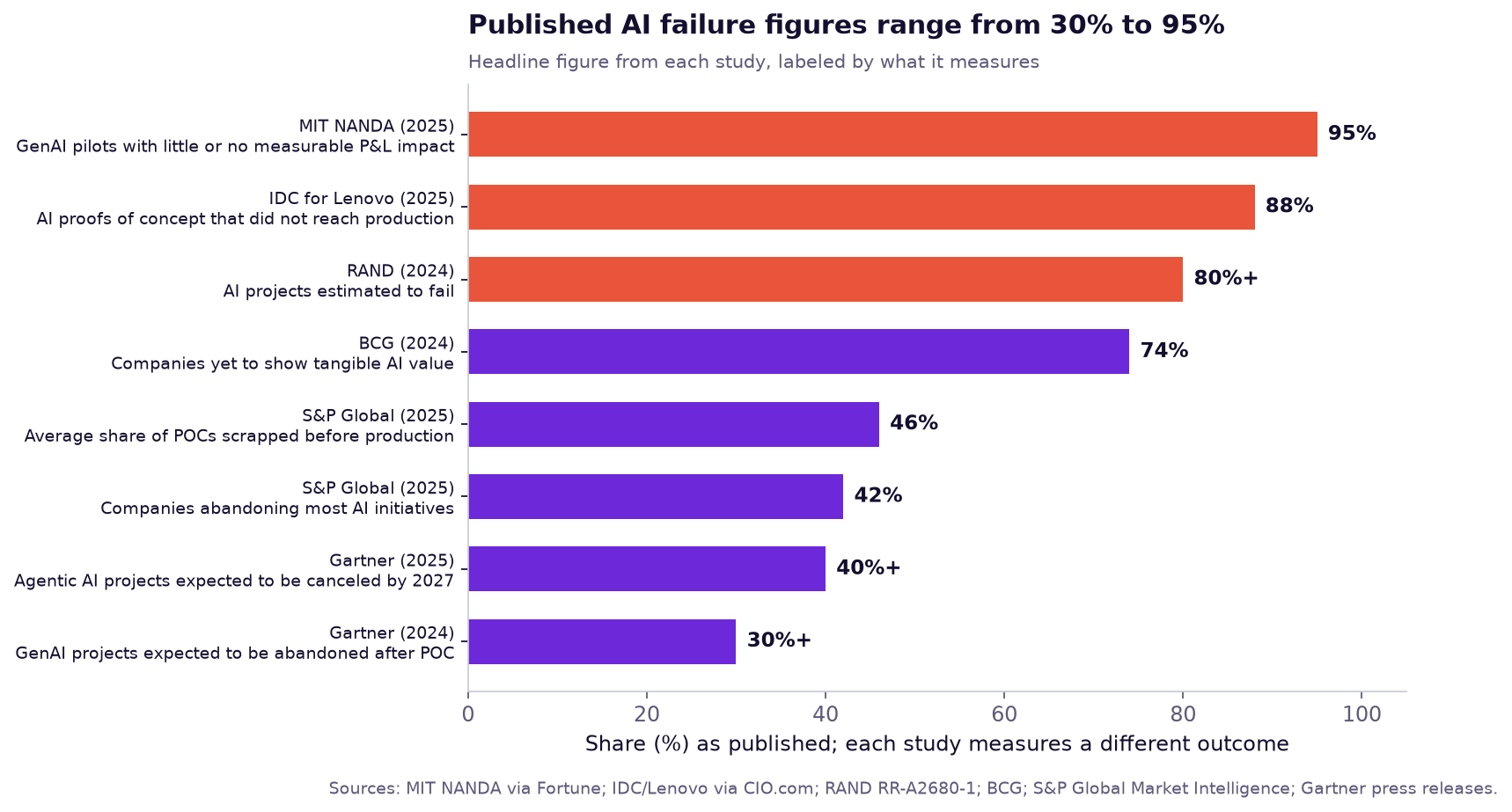
Published AI failure figures range from 30% to 95%. They differ because each study counts a different thing: pilots without profit impact, proofs of concept that never ship, abandoned programs or forecast cancellations.
Published October 2026
Key findings
- MIT NANDA found 95% of companies in its data set getting little or no measurable profit-and-loss impact from generative AI pilots.
- IDC, working with Lenovo, found that for every 33 AI proofs of concept a company launched, only four reached production, an 88% drop-off.
- S&P Global found 42% of companies abandoning most of their AI initiatives in its 2025 survey, up from 17% a year earlier.
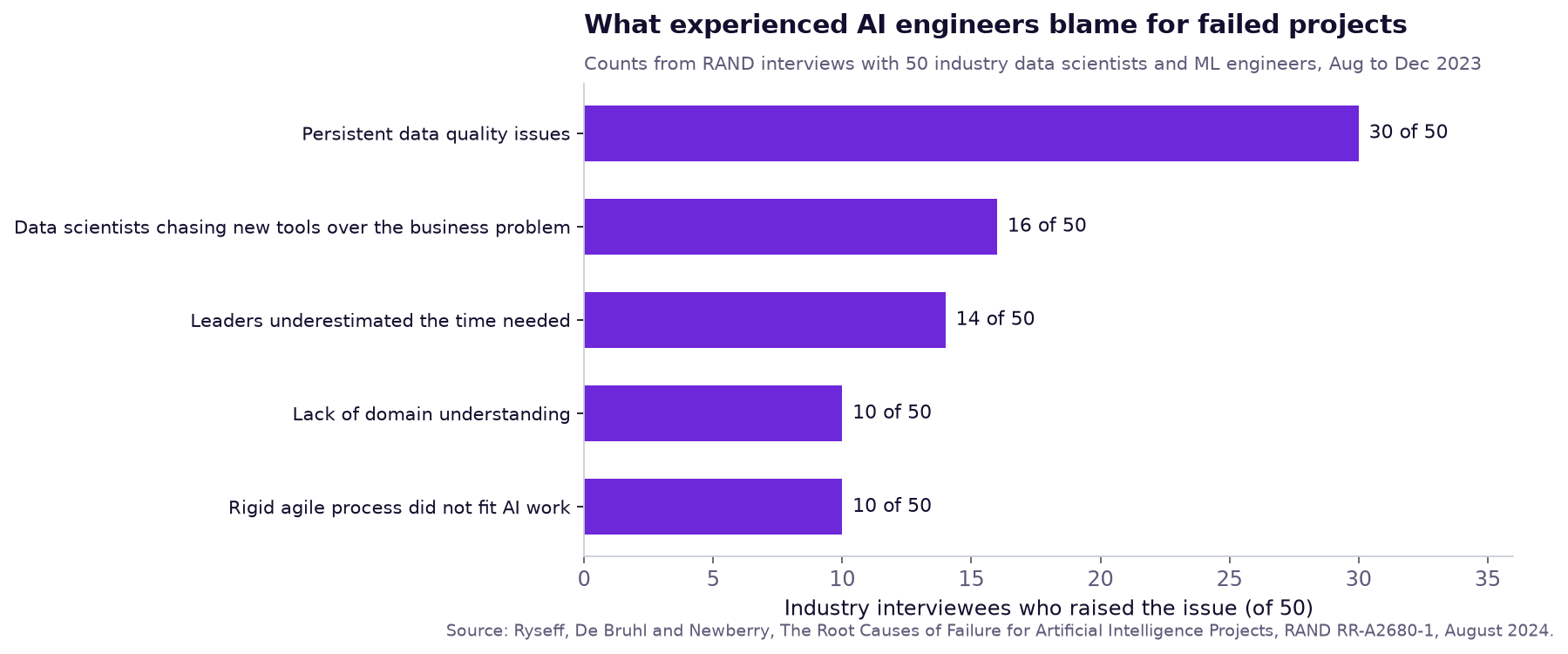
- In RAND interviews, 30 of 50 industry data scientists and engineers named persistent data quality problems as a cause of failure.
- Gartner forecasts that over 40% of agentic AI projects will be canceled by the end of 2027.
“Most AI projects fail” is one of the most repeated lines in enterprise technology. The figure attached to it changes depending on who is quoted. We collected the eight most cited studies and recorded, for each, what was measured, who was asked and when. Read side by side, they describe several different stages where AI work stops.
Failure figures by study
| Study | Figure | What it measures | Basis |
|---|---|---|---|
| MIT NANDA, The GenAI Divide (2025) | 95% | Companies whose generative AI pilots show little or no measurable P&L impact; about 5% of pilots reach rapid revenue acceleration | 150 leader interviews, a survey of 350 employees and 300 public deployments |
| IDC with Lenovo (2025) | 88% | Proofs of concept that did not reach wide-scale deployment (4 of every 33) | IDC research reported by CIO.com |
| RAND, Ryseff, De Bruhl and Newberry (2024) | More than 80% | AI projects estimated to fail, about twice the rate for IT projects without AI; cited from prior estimates | Literature, with 65 interviews (50 industry, 15 academic) |
| BCG, Where’s the Value in AI? (2024) | 74% | Companies that have yet to show tangible value from AI | Survey of 1,000 executives in 59 countries |
| S&P Global Market Intelligence (2025) | 46% | Average share of AI proofs of concept scrapped before production | Survey of 1,006 IT and business professionals in North America and Europe |
| S&P Global Market Intelligence (2025) | 42% | Companies abandoning most of their AI initiatives (17% in 2024) | Same survey |
| Gartner (June 2025) | Over 40% | Agentic AI projects forecast to be canceled by end of 2027 | Analyst forecast |
| Gartner (July 2024) | At least 30% | Generative AI projects forecast to be abandoned after proof of concept by end of 2025 | Analyst forecast |
The high figures measure value. MIT’s 95% and BCG’s 74% count companies or pilots that have not produced measurable financial returns, which includes projects still running. The middle figures measure the step from proof of concept to production: IDC’s 88% and S&P Global’s 46% average. The Gartner figures are forecasts of cancellation, not observed outcomes. RAND’s “more than 80%” is an estimate the authors cite from earlier sources, not a count from their interviews.
Abandonment rose between 2024 and 2025
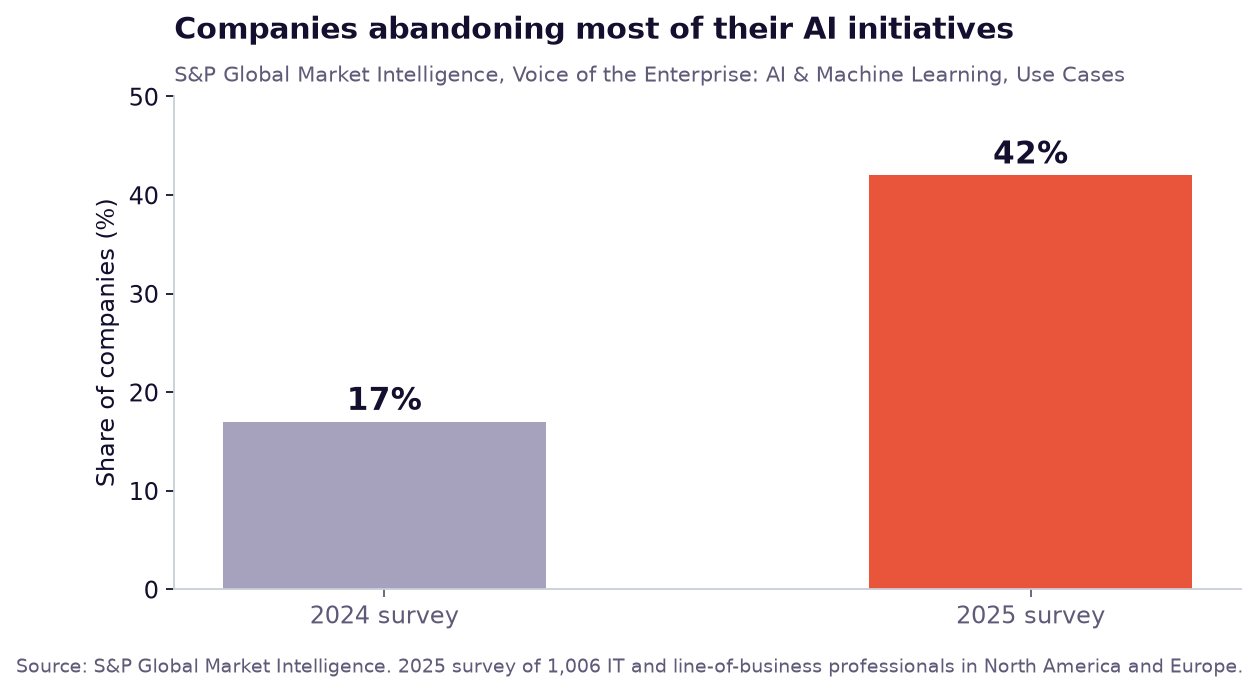
S&P Global’s survey is the only source here that measures the same question twice. The share of companies abandoning most of their AI initiatives rose from 17% to 42% in one year, and respondents named cost, data privacy and security risks as the top obstacles, according to CFO Dive’s summary. Gartner gave similar reasons for its forecasts: poor data quality, inadequate risk controls, escalating costs or unclear business value in 2024, and escalating costs, unclear business value or inadequate risk controls for agentic projects in 2025.
The causes practitioners name
| Issue raised | Interviewees (of 50) |
|---|---|
| Persistent data quality issues | 30 |
| Failures driven by data scientists pursuing new tools and techniques | 16 |
| Senior leaders underestimating the time needed to train a model | 14 |
| Lack of domain understanding on the technical team | 10 |
| Rigid interpretations of agile development | 10 |
RAND interviewed 50 data scientists and engineers in industry and 15 academics. Data quality came up most often. BCG reached a similar conclusion from the executive side: about 70% of the challenges companies reported in AI programs came from people and process issues, 20% from technology and 10% from the algorithms themselves.
What the same studies say succeeds
MIT NANDA reported that buying AI tools from specialized vendors and building partnerships succeeded about 67% of the time, while internal builds succeeded about one-third as often. BCG found that the 26% of companies it classed as AI leaders pursued about half as many opportunities as their peers and put 70% of their resources into people and processes. IDC’s 4-in-33 production rate is the more useful planning figure for a team deciding how many pilots to fund.
Sources (8)
- Fortune, “MIT report: 95% of generative AI pilots at companies are failing,” August 18, 2025
- CIO.com, “88% of AI pilots fail to reach production,” on IDC research with Lenovo
- Ryseff, De Bruhl and Newberry, The Root Causes of Failure for Artificial Intelligence Projects and How They Can Succeed, RAND RR-A2680-1, 2024
- BCG press release, “AI Adoption in 2024: 74% of Companies Struggle to Achieve and Scale Value,” October 24, 2024
- S&P Global Market Intelligence, Voice of the Enterprise: AI & Machine Learning highlights
- CFO Dive, “AI project failure rates are on the rise: report,” March 14, 2025
- Gartner press release, June 25, 2025, agentic AI cancellations
- Gartner press release, July 29, 2024, generative AI abandonment after proof of concept